Phase 1: Concrete Model – Building Your Number System

Hello, mathematicians! Today, we’re going on an exciting journey to explore numbers up to 10000. We’ll start by building our very own number system with everyday items. This will help you feel and see what these big numbers truly mean. We will learn to represent numbers using the brilliant Concrete-Pictorial-Abstract (CPA) model. Let’s begin with the Concrete phase!
For this phase, you will need:
- Approximately 200 thin drinking straws or toothpicks.
- Several small rubber bands.
- Four small paper cups or containers.
- A permanent marker.
Build your own model! Get your materials ready, and let’s construct our number system step-by-step.
Step 1: Constructing Units, Tens, and Hundreds

Let’s start with the smallest building blocks!
- Units (Ones): Take a single straw. This represents 1 unit (or one). Write “1s” on one of your paper cups.
- Tens: Count out 10 straws. Use a rubber band to carefully bundle them together. This bundle represents 1 Ten. Think of it: 10 ones make 1 ten. Place this bundle into a cup labeled “10s”.
- Hundreds: Now, take 10 of your “Tens” bundles. That’s 10 bundles, with 10 straws in each, totaling 100 straws! Use another rubber band (or two, for security) to bundle these 10 tens together. This larger bundle represents 1 Hundred. Place it into a cup labeled “100s”.
You’re building the foundation of our place value system!
Step 2: Building a Thousand
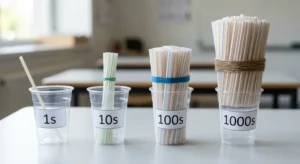
Fantastic work so far! Now, for the biggest leap: the Thousands.
- Thousands: Imagine taking 10 of your “Hundreds” bundles. That’s 10 bundles, each containing 100 straws! Count them: 10 x 100 = 1000 straws. Secure these 10 hundred-bundles together with a strong rubber band. This massive bundle now represents 1 Thousand. Place this into your last cup, labeled “1000s”.
Congratulations! You have just constructed a physical representation of our number system, showing the relationship between units, tens, hundreds, and thousands. Notice how each group is made up of 10 of the group before it. This is the power of our base-10 number system!
Phase 2: Pictorial Representation – Visualizing Numbers
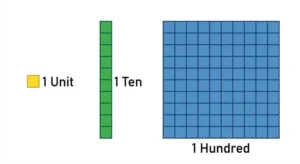
Now that you’ve built your physical models, let’s transition to the Pictorial phase. Here, we will draw what we’ve just built. Imagine replacing your straw bundles with simple, clear drawings. This helps us visualize numbers without needing to build them every time!
- Units (Ones): We represent a single unit with a small square or a dot.
- Tens: A bundle of ten units is shown as a long rectangular bar, representing 10 small squares joined together.
- Hundreds: A bundle of one hundred units (or ten tens) is drawn as a flat square block, representing 10 ‘tens’ bars joined.
These simple drawings help us easily count and compare numbers!
Visualizing Thousands
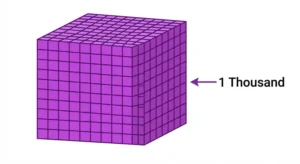
Just like we moved from units to tens and hundreds, we can extend our visual representation to thousands.
- Thousands: A bundle of one thousand units (or ten hundreds) is represented as a large cube or a thick block. Imagine stacking 10 of your ‘hundreds’ flat blocks on top of each other – it forms a cube! This clearly shows its value relative to the smaller units, tens, and hundreds blocks.
These pictorial models are powerful tools for understanding place value because they directly translate your concrete experience into a visual one.
Representing Numbers with Pictures
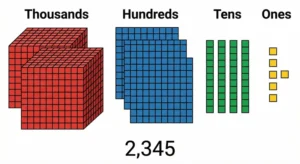
Let’s see how we can represent a four-digit number like 2,345 using our pictorial models.
- Thousands Place (2): We would draw two ‘thousands’ blocks.
- Hundreds Place (3): We would draw three ‘hundreds’ blocks.
- Tens Place (4): We would draw four ‘tens’ bars.
- Ones Place (5): We would draw five ‘units’ squares.
By looking at these pictures, you can immediately see the value of each digit based on its place!
Understanding Place Value Pictorially
The position of a digit in a number tells us its value. This is called place value. Let’s look at the number 2,345 again using a pictorial place value chart.
- Thousands Place: The digit ‘2’ is in the thousands place, so its value is 2 x 1000 = 2000.
- Hundreds Place: The digit ‘3’ is in the hundreds place, so its value is 3 x 100 = 300.
- Tens Place: The digit ‘4’ is in the tens place, so its value is 4 x 10 = 40.
- Ones Place: The digit ‘5’ is in the ones place, so its value is 5 x 1 = 5.
This visual chart helps us break down any number and understand the value of each digit.
Phase 3: Abstract Phase – The Language of Numbers
Now that you’ve built and visualized numbers, let’s move to the Abstract phase. This is where we use mathematical symbols, definitions, and rules to represent and understand numbers. This is the formal language of mathematics!
Key Definitions:
- Digit: A single symbol used to make numbers (0, 1, 2, 3, 4, 5, 6, 7, 8, 9).
- Place Value: The value of a digit based on its position in a number.
- Ones Place: Value is multiplied by 1.
- Tens Place: Value is multiplied by 10.
- Hundreds Place: Value is multiplied by 100.
- Thousands Place: Value is multiplied by 1000.
- Digit Value: The actual value of a digit in a number, determined by multiplying the digit by its place value.
For example, in the number 2,345:
- The digit ‘2’ is in the thousands place, so its digit value is 2 x 1000 = 2000.
- The digit ‘3’ is in the hundreds place, so its digit value is 3 x 100 = 300.
- The digit ‘4’ is in the tens place, so its digit value is 4 x 10 = 40.
- The digit ‘5’ is in the ones place, so its digit value is 5 x 1 = 5.
Representing Numbers in Different Forms
Numbers can be written in several different forms, and understanding these helps us work with them.
-
Standard Form: This is the usual way we write numbers using digits.
- Example: 2,345
-
Expanded Form: This shows the number as the sum of the values of its digits.
- Example: 2,000 + 300 + 40 + 5
-
Word Form: This is when we write the number out in words. Remember to use a comma when reading numbers with thousands.
- Example: Two thousand, three hundred forty-five
Pro-Tip: Always remember the comma in the thousands place! It helps you read large numbers correctly. “Two thousand three hundred forty-five” is easier to understand as “Two thousand, three hundred forty-five.”
Understanding the Power of Place Value: Pro-Tips!
You’ve done an amazing job building, visualizing, and now formalizing your understanding of numbers up to 10000! Here are some final pro-tips to help you master this concept:
- Always Think in Groups of Ten: Remember that 10 ones make 1 ten, 10 tens make 1 hundred, and 10 hundreds make 1 thousand. This “x10” relationship is key to our number system.
- Visualize: If you ever get stuck, mentally picture your straw bundles or the pictorial blocks. Which place is bigger? Which is smaller?
- Practice Decomposing Numbers: Try taking any 4-digit number and breaking it down into its thousands, hundreds, tens, and ones. Then, try building it back up!
You now have the tools – concrete, pictorial, and abstract – to confidently work with numbers up to 10000! Keep practicing, and you’ll become a number expert!